Meet your tireless red teamer
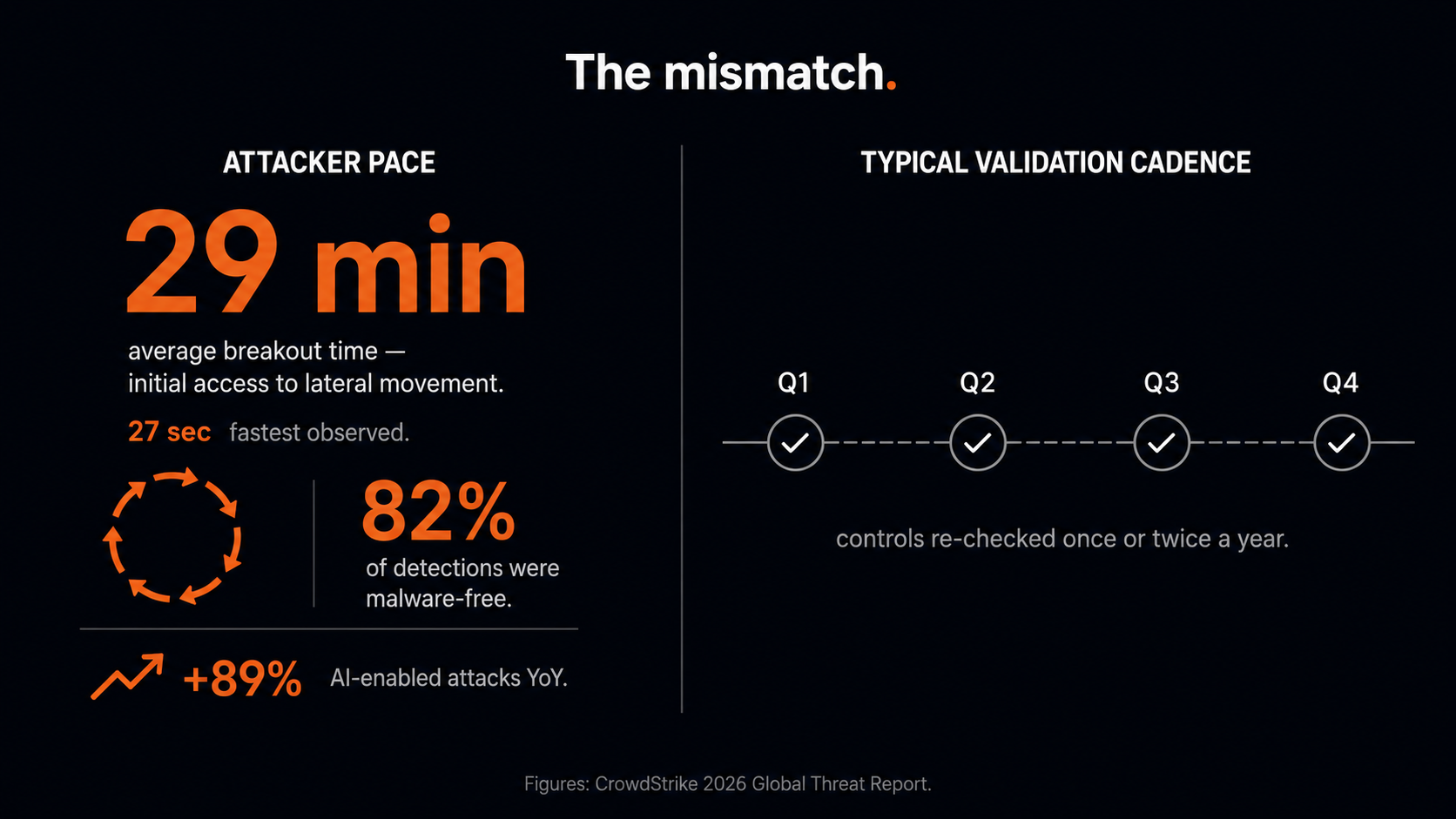
CrowdStrike’s 2026 Global Threat Report put a number on something defenders have felt for a while: attacks from AI-enabled adversaries rose 89% over the prior year. The detail that matters more than the headline is what the report says AI is doing. It isn’t inventing new categories of attack. It’s making the familiar ones faster and cheaper to run, which means attacker tactics now change faster than most security programs re-check their own defenses.
For a security leader, that creates a specific problem. The pace of attacker iteration has gone up, and the shelf life of any given assessment has gone down. A control that passed last quarter’s review can drift out of step with how adversaries behave today, and the first sign of it is usually an incident.
This post isn’t here to re-report a threat landscape you’ve already read about. It’s about what a leader can do with it: how to tell whether your program is keeping pace, what to measure, and where a continuous validation model actually changes how your team operates. We call that capability a tireless red teamer, and it’s what FourCore ATTACK is built to be. Not a mascot, and not a replacement for skilled human red teaming, but a standing source of evidence that your defenses still hold.
A quick test for your own program
Before any tooling conversation, three questions tell you whether your validation cadence has fallen behind your change rate:
- The last time you tuned a detection or changed a control, do you have evidence the change improved a specific outcome, or only that it shipped?
- For the attacker techniques most relevant to your business, can you state right now how many are prevented, how many are only logged, and how many are missed?
- If your board asked whether you are measurably better defended than last quarter, could you answer with data rather than narrative?
If those answers are uncomfortable, the gap isn’t your tooling budget. It’s that your defenses are being changed and assumed to work, with nothing confirming they do. Closing that gap is the entire job of adversarial exposure validation.
What continuous validation actually does
FourCore ATTACK safely emulates real adversary techniques against the controls doing the work in an enterprise, endpoint security, email, the web gateway, the WAF, and data leakage protection, then turns the result into evidence rather than a checkbox. The useful questions get answered concretely. Did the endpoint stack stop the behavior or just log it? Did email block the payload before anyone clicked? Did the WAF catch the exploit pattern that mattered? Did the SOC get enough telemetry to investigate? And when you pushed a fix, did re-running the same scenario actually show improvement?
What changes operationally is the loop. Tuning gets a closing step, re-test instead of deploy-and-hope. Purple teaming becomes a standing cadence rather than an annual event. And because every run is recorded, audit evidence is produced as a byproduct instead of assembled in a fire drill, which for regulated sectors maps onto SEBI CSCRF, RBI, and similar control-validation expectations. The compliance artifact and the security outcome stop being two separate projects.
The number to put in front of your board
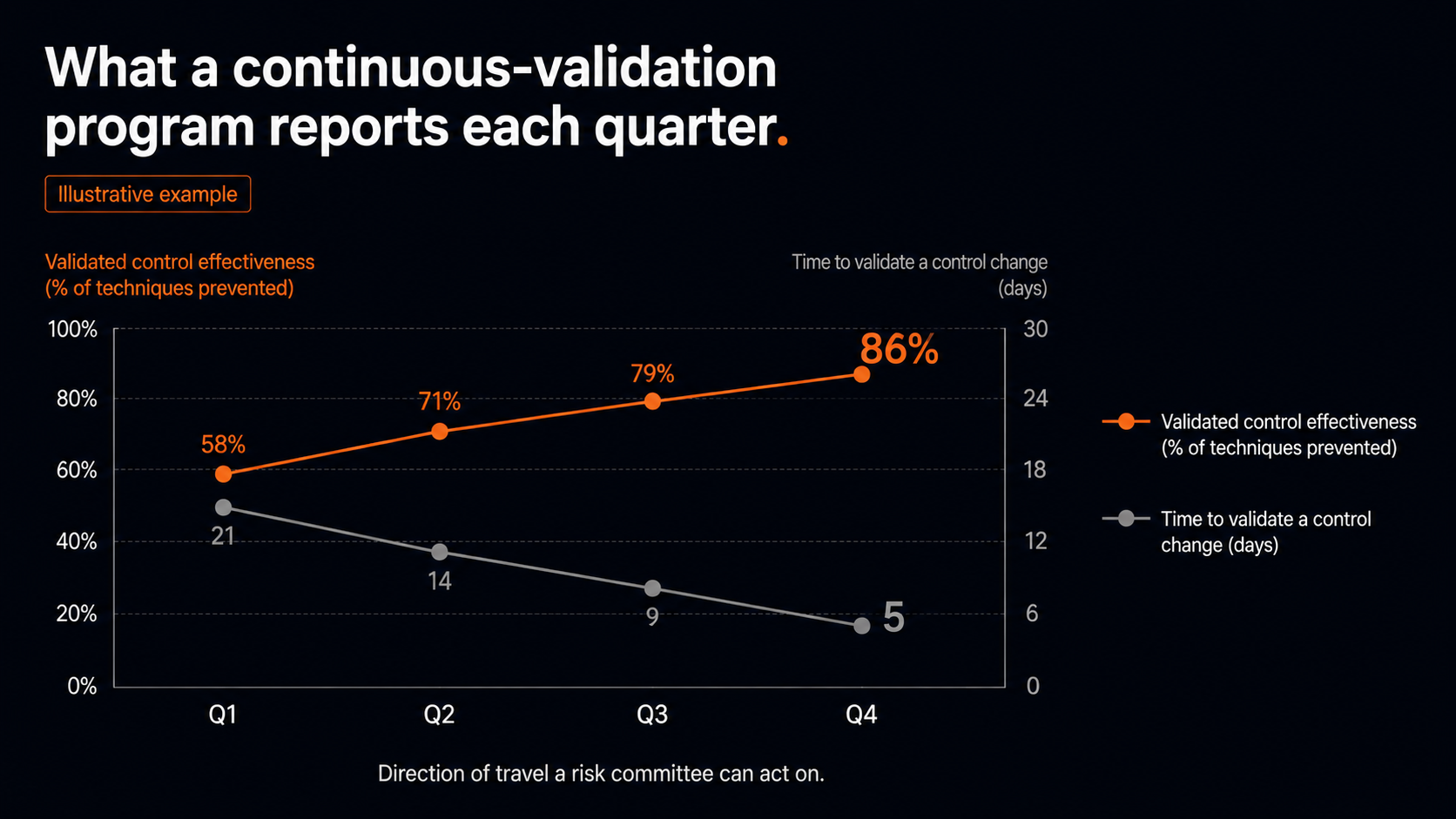
Attackers already have a clock you can quote. CrowdStrike measured average breakout time, the gap between initial access and lateral movement, at 29 minutes last year, with the fastest at 27 seconds. Defenders need the mirror of that: a number that trends over time and answers whether you are improving.
Two are worth owning. First, validated control effectiveness, the share of the techniques you emulate that are prevented versus only detected versus missed, tracked quarter over quarter. Second, time to validate, how long after a control change or a new threat before you have evidence it holds. Both are board-legible, both move with the work your team does, and both turn “we feel covered” into a direction of travel you can defend a budget against. A program that can show those two lines improving is having a different conversation with its risk committee than one bringing adjectives.
Why AI moved this up your priority list
The reason this is now urgent rather than aspirational sits in the same reporting. Alongside the 29-minute breakout, CrowdStrike found 82% of detections last year were malware-free, the profile of an attacker who logs in on valid credentials rather than dropping a file the stack is tuned to catch. Google’s Threat Intelligence Group documents the same compression of attacker timelines, and this year caught the first in-the-wild zero-day it believes was AI-developed before it could be used at scale. None of this means every attacker is suddenly elite. It means the floor is rising and the clock is faster, and a validation cycle measured in quarters cannot keep up with an iteration loop measured in days.
What it won’t do
It’s worth being straight about the boundary. Automated emulation validates how your known controls behave against known and emerging techniques. It does not replace human threat hunting, the creativity of a skilled red team, or judgment about a genuinely novel attack outside any library. The value is coverage and cadence, running the checks no human can run continuously, so your people spend their scarce hours on the problems that actually need them. A tool that claims to replace that judgment is overselling. This one is built to free it up.
The operating model ahead
The teams that hold up best against AI-assisted threats won’t be the ones with the longest tool list. Every control you add widens the surface you then have to keep validating, which makes validation capacity, not control count, the real constraint on whether your stack works. The advantage goes to the shortest loop between assess, validate, remediate, and validate again.
That is what the “tireless” part means in practice. The modern attacker’s edge isn’t one clever exploit, it’s the speed of iteration, and a human-led engagement runs on a calendar it can’t beat. A standing validation capability can re-test the same controls every time attacker behavior shifts or your own configuration drifts, so the evidence about whether your defenses work is never more than a run old. In a landscape that moves this fast, validation can’t be a date on the calendar. That is the job FourCore ATTACK is built to do.