CISO outcome
Prioritize the gaps that matter, track remediation, and show whether the control improved.
Breach and Attack Simulation
FourCore ATTACK brings agentic workflows to controlled adversary emulation against the defenses your team relies on. See what was blocked, what was detected, and what needs attention.
For teams responsible for detection, response, and control assurance.
Outcomes across the organization
CISO outcome
Prioritize the gaps that matter, track remediation, and show whether the control improved.
SecOps outcome
Reproduce behavior, inspect telemetry, tune detections, and retest without waiting for the next incident.
What is BAS?
Breach and Attack Simulation is an automated security validation method that safely emulates adversary techniques against an organization's controls. BAS shows whether defenses block, detect, log, or miss those techniques, giving security teams evidence they can use to prioritize remediation.
BAS complements penetration testing and red teaming. It adds repeatable validation between periodic engagements and after changes to the environment, so security teams can measure control effectiveness instead of assuming it.
New to the category? Read our plain-language guide to what BAS is and how it works, or see the concise BAS definition.
Show the work
The useful output is not a green checkmark. It is the technique, the control response, and the evidence your team needs to investigate, remediate, and retest.
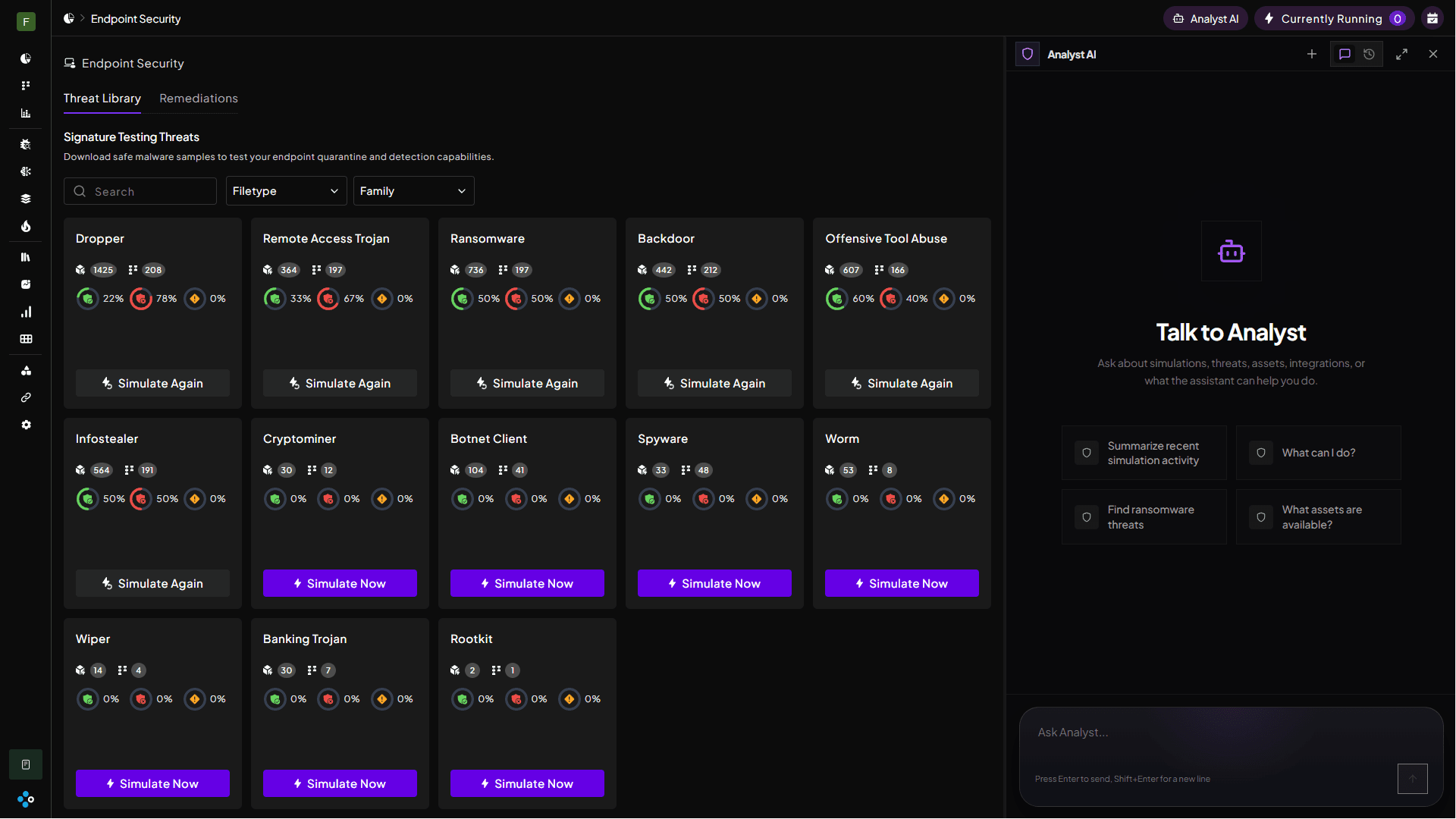
How BAS works
Choose a technique, run a controlled test, inspect the result, and retest after remediation.
Select a relevant adversary behavior, campaign, or MITRE ATT&CK technique to validate.
Execute a controlled test against the security controls in the environment you need to understand.
See what was blocked, detected, logged, or missed, with evidence tied to the simulated activity.
Use the finding to tune controls, create detections, assign remediation, and verify that the gap is closed.
Control coverage
Start with the controls and techniques that matter to your environment. Then use the results to decide what needs to change.
Test whether endpoint controls detect and prevent adversary behavior, not just known file signatures.
Validate segmentation, firewall, IDS, and IPS controls against realistic attack techniques.
Safely test whether email security controls identify malicious delivery and execution paths.
Generate evidence your detection and response teams can investigate, tune, and retest.
Exercise WAF and application defenses against relevant attack techniques and paths.
Validate whether sensitive-data controls identify and stop simulated exfiltration behavior.
Operational use cases
Validate whether new and existing detections fire against the behavior that matters to your environment.
Exercise prevention, detection, and response controls against ransomware-relevant techniques without waiting for an incident.
Measure technique coverage and expose gaps with results mapped to a framework security teams already use.
Retest after an EDR, SIEM, firewall, email, or policy change to reduce configuration drift and regression risk.
Choose the right validation method
Each method answers a different question. Use them together according to risk, scope, and how often you need to validate a control.
| Method | Primary purpose | Cadence | Typical output |
|---|---|---|---|
| Vulnerability scanning | Finds known weaknesses | Frequent | Vulnerability inventory |
| Penetration testing | Manually exploits selected weaknesses | Periodic | Exploit findings and report |
| Red teaming | Tests people, process, and defenses | Periodic | Exercise outcomes |
| BAS | Continuously validates security controls | Repeatable | Block, detect, and miss evidence |
Read the detailed BAS vs penetration testing comparison and explore related validation methods.
Why FourCore ATTACK
Validate behavior-based defenses with controlled simulations rather than relying only on static signatures.
Give defenders technical context they can use for investigation, hunting, remediation, and retesting.
Connect detection engineering, SOC, red team, and leadership conversations to the same evidence.
Run the loop again after a fix or change and measure whether the control outcome improved.
BAS questions answered
Breach and Attack Simulation (BAS) is an automated security validation method that safely emulates adversary techniques against an organization's controls. It shows whether defenses block, detect, log, or miss the behavior, giving security teams evidence they can use to prioritize remediation.
A BAS platform can test controls such as EDR, SIEM, firewalls, email security, WAF, DLP, and network defenses. The exact scope depends on the platform, deployment model, integrations, and simulations it supports.
Penetration testing is a manual, point-in-time engagement focused on exploiting selected weaknesses. BAS is automated and repeatable, helping teams validate control effectiveness between pentest cycles and after changes to the environment.
No. BAS and red teaming answer different questions. Red teams test adversary behavior, people, processes, and defenses through human-led exercises, while BAS provides repeatable automated validation of security controls. Mature programs use both.
A useful BAS result identifies the technique attempted, the control tested, whether the behavior was blocked, detected, or missed, the evidence generated, and the remediation or detection action needed. Retesting should show whether the gap was closed.
BAS must be designed around controlled, authorized simulations, clear scope, and safety controls. Before running a test, teams should understand the technique, target, delivery mechanism, production impact, and rollback or containment process.
Start with one control gap
Bring a threat, technique, or control gap you need to understand. We'll show how FourCore ATTACK can run a controlled validation, capture the result, and help your team decide what to do next.
Book a BAS demo