
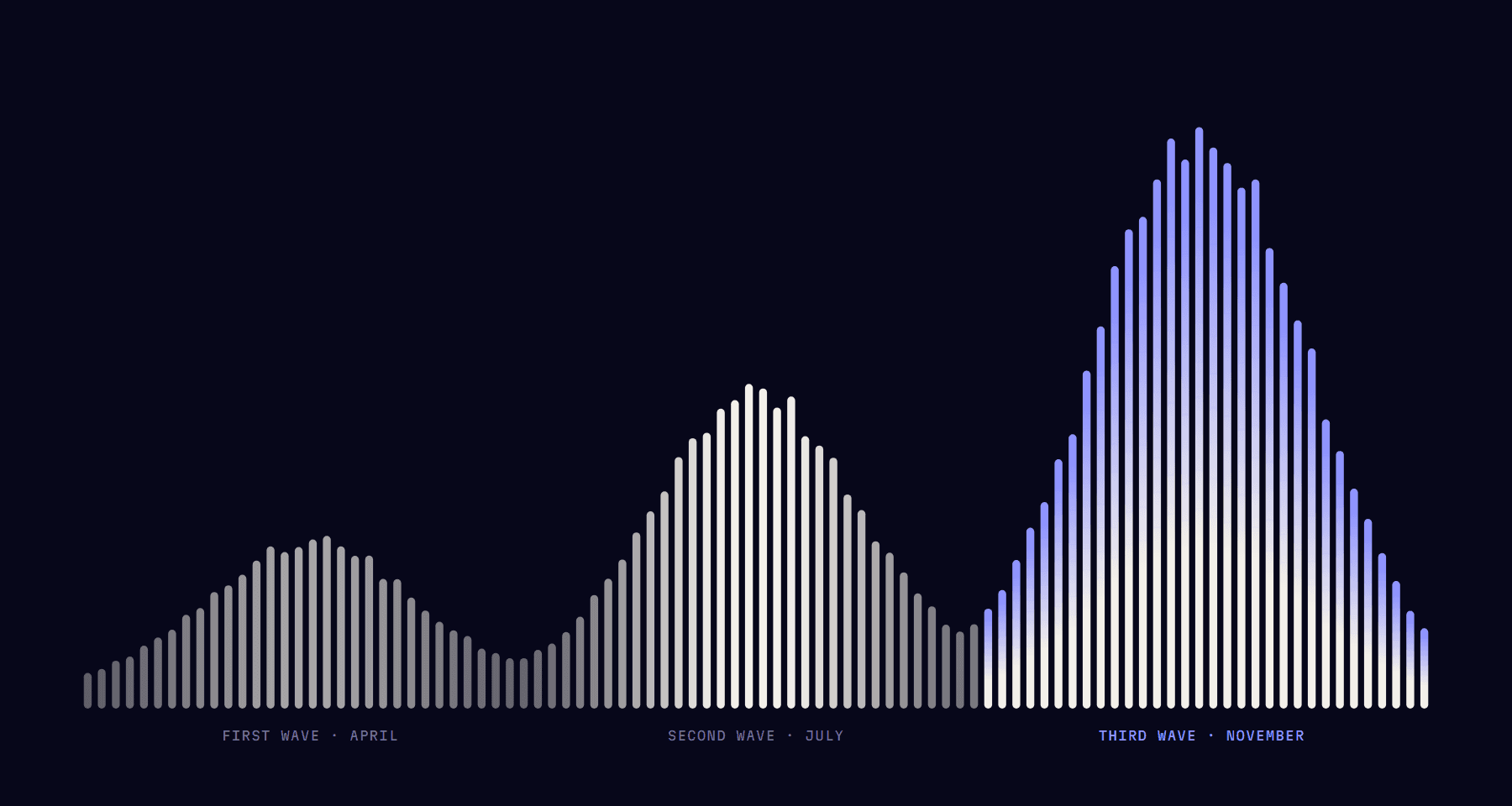
The Cloud Security Alliance CISO community published The Third Wave: ARTEX and Agentic Offensive Frameworks in November 2026. Unlike most writing on AI-run attacks, it reports what already happened. More than 800 CISOs joined an emergency call four days after the FBI issued a FLASH alert on ARTEX. Attackers had already compromised some of the people on that call, and they shared what worked and what failed.
Key takeaways
- An agentic offensive framework (AOF) such as ARTEX runs an intrusion from end to end on an AI model. Check Point Research estimates the model cost of a campaign at $145 to $1,500.
- The FBI describes some intrusions that reached privileged access in under three hours.
- Most campaigns used known techniques. What changed is the cost of an attempt, so the defender's problem is volume.
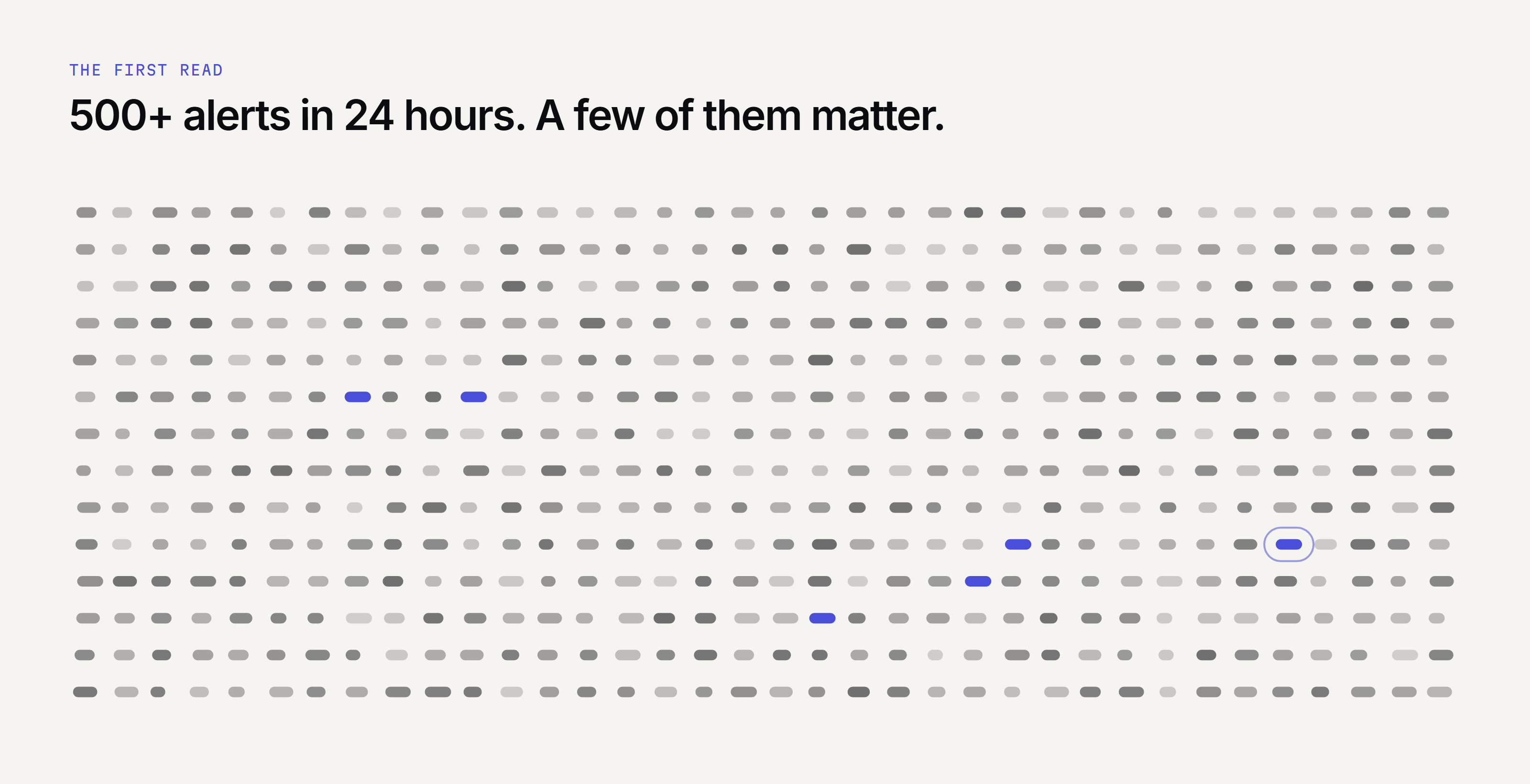
- The teams that kept pace used AI agents throughout their work. One exercise in the briefing set off more than 500 alerts in 24 hours.
- Four controls to start with: attack your own surface, make an agent the first reader of every alert, plant decoys, and remediate completely before you retest.
- Most security work is intelligent busywork that comes before a decision. An agent can do that work today, and your team keeps the decisions.
What is an agentic offensive framework (AOF)?
An agentic offensive framework is software that runs an intrusion from end to end on an AI model. An operator gives it a target and an objective. It plans the work, runs standard tools and tries another route when one fails. ARTEX is the framework the FBI named in its alert of November 13, 2026.
The briefing calls this the third wave of AI-driven attacks. In the first wave, a frontier model found vulnerabilities and wrote exploits faster than human teams. We wrote about that wave in Mythos-Class AI and the End of the Patch Window. In the second wave, an autonomous attack ran end to end against production infrastructure. In the third, adversaries run autonomous campaigns with downloadable frameworks and low-cost models.
Why agentic attacks change the defender's problem
Most of the attacks in the briefing are not sophisticated. The briefing says most campaigns used known techniques, and that defenders could detect their noisy reconnaissance. What changed is cost and reach.
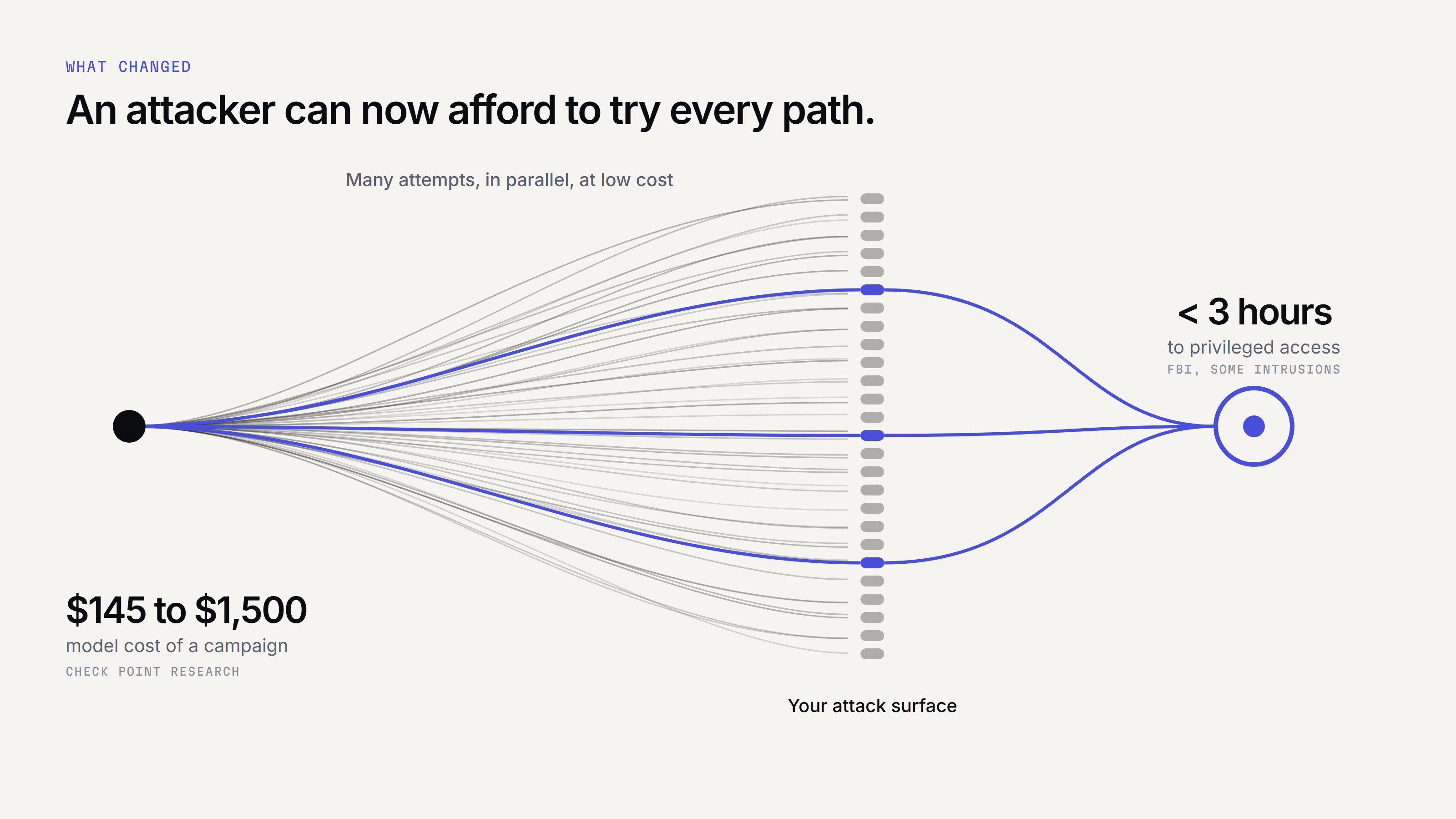
Check Point Research estimates the model cost of a full campaign at $145 to $1,500. The FBI describes some intrusions that reached privileged access in under three hours. A path that was too tedious for a human attacker is practical for software that retries at low cost.
For defenders, this makes volume the problem. Security teams already know these techniques. A team can read, check and test only so much in a day, and an attacker who can afford a thousand attempts now decides how much arrives. The result is alert fatigue at a new scale.
The briefing's summary describes the result:
Teams that used AI agents throughout their work kept pace, and others described being overwhelmed.
Which CSA controls should you start with?
The briefing lists twenty controls. We would start with these four, because each one answers something that happened in a real incident.
1. Shrink the attack surface, then attack it yourself. Attackers came in through forgotten systems, public code, and exposed sign-up and password reset flows. The briefing asks teams to take unused interfaces off the internet. Then it asks them to run a vetted framework against themselves in an isolated environment. It also warns that a lab run will not fully act like an uncontrolled one. Adversarial Exposure Validation is the continuous form of this control.
2. Make an agent the first reader of every alert. We think this is the best-designed control in the document, because it comes with three limits. The agent is read-only by code. It attaches evidence to each verdict. A person reviews a sample of the alerts it closes as benign. With those limits, a team can use the agent before it fully trusts it.
3. Plant decoys. Canary keys and decoy accounts slowed or stopped teams of agents. A decoy alert does not depend on recognizing the attacker's tool. That matters now, because ARTEX has no canonical build left to write a signature for. One study in the briefing routed the framework to an isolated shadow copy, and successful compromises fell from 50% to 0%.
4. Remediate completely, then retest. Attackers compromised organizations again within hours when they had cleaned up only part of an intrusion. One framework lost its foothold and came back through a second flaw. The briefing tells teams to preserve evidence, revoke, rebuild and retest.
The briefing also says what does not work yet. It cites a 2026 benchmark in which frontier models with containment authority had false positive rates of 45% to 82.5%. The authors still recommend pre-authorized containment, with limits on blast radius. They list liability for a wrong shutdown as an open question. We think that is the right way to write about automation. The authors recommend it and state what it costs.
Where we would go further
Ask which loop the human is in
The briefing's first conclusion is that human-in-the-loop approvals cannot match the speed of these attacks. We agree for containment. For the rest of security operations, the answer depends on which loop the person is in.
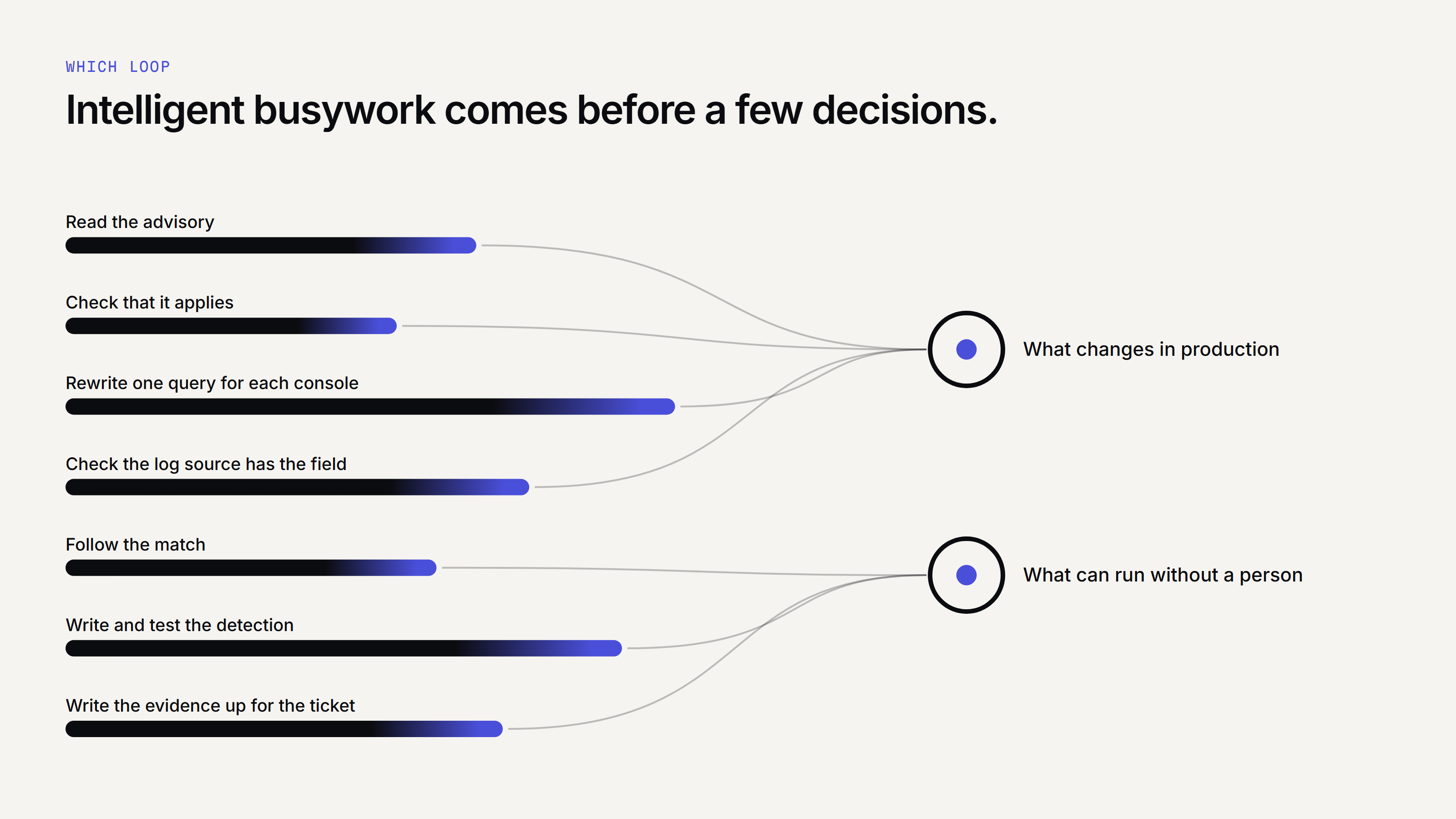
Most of a security team's day comes before a decision, and much of it is intelligent busywork. A skilled person has to do it. It exists because of how the work, the tools and the systems around them were designed.
Each tool has its own query language, console and alert format, so a person becomes the integration layer between them. An analyst reads the advisory and works out whether it applies. The analyst then rewrites one question for three consoles, checks that the log source carries the field, follows the match and writes the detection. After that, the same analyst writes the evidence up again for the ticket.
None of this is a decision, and none of it changes production. It also cannot match the speed of an agentic attack. A framework that retries along several paths at once does not wait while someone rewrites a query. An agent can do this work today, which is the idea behind agentic SecOps.
A few decisions remain, such as what changes in production and what can run without a person. A team that gives the busywork to an agent has more attention for them.
Detect the behavior, and test that you can
Decoys are one answer to detection that goes stale. A second answer is to stop tying detection to the tool. ARTEX builds already diverge. The behavior they automate changes far less: credential access, directory enumeration, lateral movement, new credentials on an existing OAuth application.
A detection written for the behavior still works when the next framework appears. This is ordinary detection engineering, and you still have to test it, because a rule can exist and not fire. In one incident in the briefing, a WAF stopped the reconnaissance and missed the breach.
Test a new control before you rely on it
The briefing asks boards to approve a buying process that can adopt a new defense within two to four weeks. We sell security software, so a faster buying cycle helps us. We would still add one condition. Run the new control against the attacker behavior it claims to stop, in your own environment, before you rely on it. If you skip that step, you add a tool and do not know if you added protection.
How FourCore Analyst does this work
FourCore Analyst is the AI agent built into FourCore ATTACK and FourCore HUNT. We built it to do the intelligent busywork that comes before a decision. Here is that work in three recent customer environments.
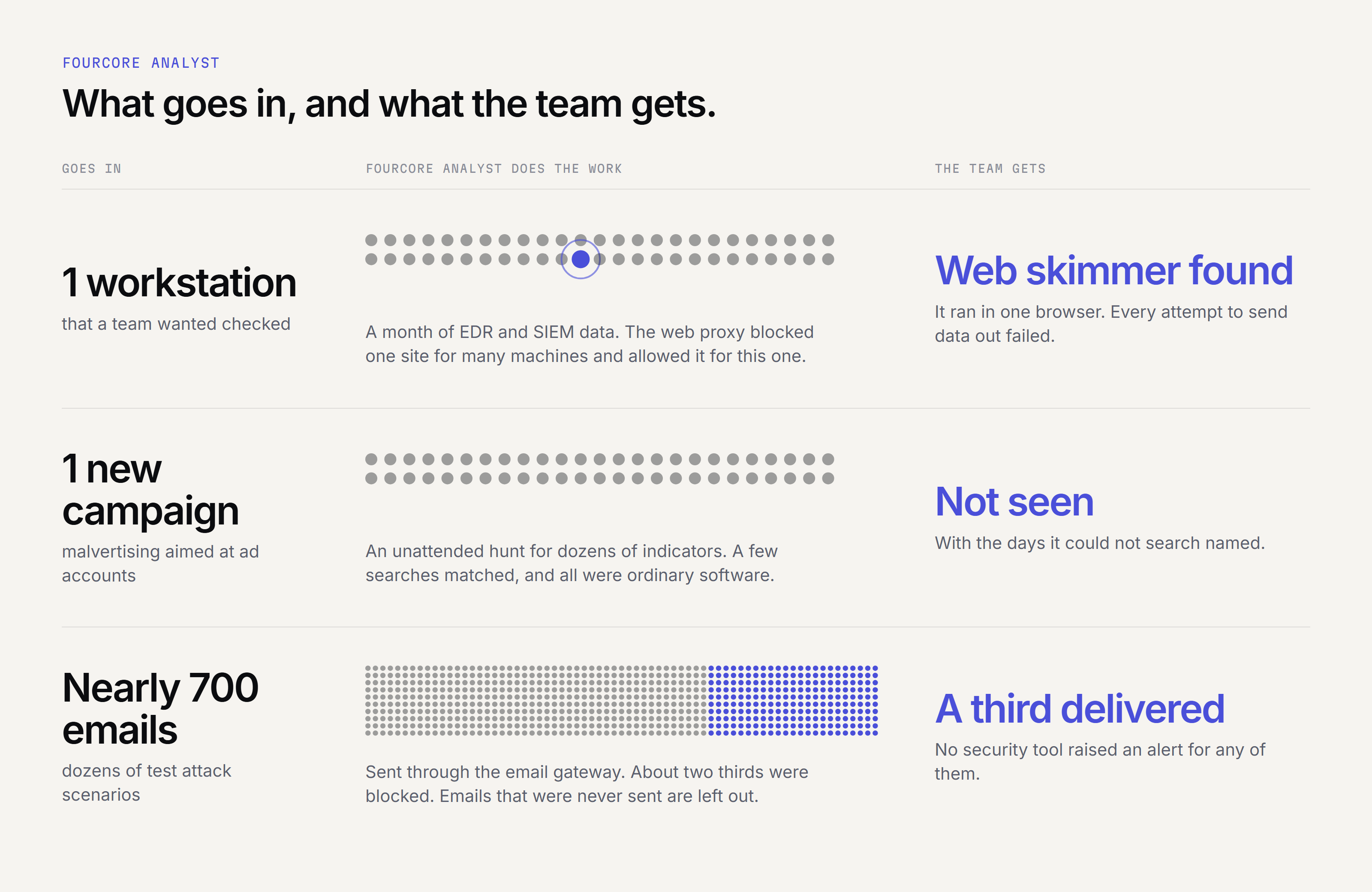
One workstation, and a web skimmer with no EDR alert
A security team asked FourCore Analyst to investigate one workstation. FourCore Analyst searched a month of EDR and SIEM data for it. When a search returned nothing, it ran the same search on a control host to confirm that the search could see that kind of event.
It found a web skimmer. A user had opened a lookalike of a financial site, and the page loaded skimmer scripts in the browser. The browser then made dozens of attempts to send data to a collection server, and every one failed. The web proxy had blocked that site for many other machines and allowed it for this one. No EDR alert had fired for the machine in that month.
FourCore Analyst also reported what it did not find: no persistence, no credential access and no lateral movement. It listed the actions for the team and stated its limits: how far back the endpoint data reached, which events the SIEM did not hold, and that it could not see whether the collection server kept anything.
A new malvertising campaign, hunted with nobody waiting
FourCore HUNT hunts new campaigns without a request. For one security team, FourCore Analyst picked up a malvertising campaign that targets business advertising accounts. It read the campaign record and the public research. Then it searched the team's endpoint telemetry for every campaign domain and file hash, the browser extensions the campaign installs and the scheduled tasks it creates. Hunts only read data.
A few searches matched, and FourCore Analyst traced each one to ordinary software. Its answer was "not seen", with the limit attached. The endpoint tool held less data than the hunt's 30-day window, so FourCore Analyst named the days it could not search. It recorded the answer and suggested a daily watch.
Nearly 700 test emails, and the third that reached the inbox
Another team ran dozens of email attack scenarios through its email gateway with FourCore ATTACK. A team member asked FourCore Analyst for a detailed report. The gateway blocked about two thirds of the payloads and delivered about a third. No security tool raised an alert for any of them.
A few payloads were never sent. The first version of the report counted them as blocked. FourCore Analyst checked its figures against the run totals, found the mismatch and removed them, so the blocked rate did not look better than it was. The team got a breakdown for each payload, from the scenarios the gateway fully blocked to the ones it fully delivered, with recommendations.
Where this meets the briefing
The briefing warns that attackers now plant markers that tell a defender's AI to treat their activity as an authorized test. Its control is to verify authorization outside the alert, against a register of approved tests. FourCore HUNT works the same way. It attributes a match to one of your own emulations only when FourCore's record shows an emulation on the same host, at the same time, with the same recorded indicator. It does not accept a claim inside the telemetry.
FourCore does not isolate hosts or contain an intrusion, and it does not build decoys. Those controls belong in your program, and the briefing describes them well. FourCore integrates with the SIEM and EDR you already run.
The briefing also has a page for vendors. It asks vendors to stay available when attackers hit many customers at once, and to expect attacks on themselves. It asks them to give customers ways to scope, monitor and revoke what an agent can reach. We use that page as a checklist for our own product. Customers should ask every vendor those questions, and that includes us.
Where should a security team start?
If you read one section of the briefing, read the top three risks and their "start this week" actions. Lock down the entry points of your three most critical applications. Connect an investigation agent to your security tools and logs, read-only. Put canary keys where an attacker's agent will look.
Then ask the question the briefing gives to boards: have we run this kind of attack against our own environment in a safe test, and what did it find?
Thank you to the CSA CISO community and the authors for publishing quickly, and for naming the questions that are still open.
Frequently asked questions
What is an agentic offensive framework (AOF)?
An agentic offensive framework (AOF) is software that runs a cyber intrusion from end to end on an AI reasoning model. An operator gives it a target and an objective in plain language. The framework plans the work, runs standard attack tools and tries another route when one fails. The Cloud Security Alliance CISO community uses the term in its November 2026 briefing.
What is ARTEX?
ARTEX is an agentic offensive framework that the FBI covered in FLASH alert FLASH-20261113-001 on November 13, 2026. SentinelOne counts at least five actors and clusters that have used it since late August 2026, from espionage groups to criminal clusters. The CSA briefing says ARTEX no longer has one canonical build, so detection tied to a single version goes stale quickly.
How much does an AI-run intrusion campaign cost?
Check Point Research estimates the AI model cost of the ARTEX cybercrime campaigns it documented at $145 to $1,500 per campaign. The FBI describes some intrusions that reached privileged access in under three hours. The CSA briefing concludes that low cost and wide reach, more than new techniques, are what changed.
Which controls does the CSA briefing recommend first?
The briefing names three top risks and a control for each:
- Shrink your attack surface and test it with a framework in an isolated environment.
- Put AI agents into security work, starting with an investigation agent that is read-only by code.
- Plant decoys such as canary keys and decoy administrator accounts.
It also tells teams to remediate a compromise completely, because partial cleanup led to re-compromise within hours.
Can AI agents be trusted with security operations?
The CSA briefing recommends agents with limits. Its first control makes an agent the first reader of every alert, read-only by code, with evidence attached to each verdict and a person reviewing a sample of benign closures. It is more careful about automated response. It cites a 2026 benchmark in which frontier models with containment authority had false positive rates of 45% to 82.5%.
How does FourCore Analyst help against agentic attacks?
FourCore Analyst is the AI agent built into FourCore ATTACK and FourCore HUNT. In FourCore ATTACK it emulates new threats against your real controls, correlates the results with your EDR and SIEM, engineers the detection or hardening change, and re-runs the emulation to verify the mitigation. In FourCore HUNT it does agentic threat hunting: it hunts new campaigns across your SIEM and EDR, read-only, and investigates every match. FourCore does not contain intrusions or build decoys.
Source: The Third Wave: ARTEX and Agentic Offensive Frameworks, CSA CISO community, November 2026.