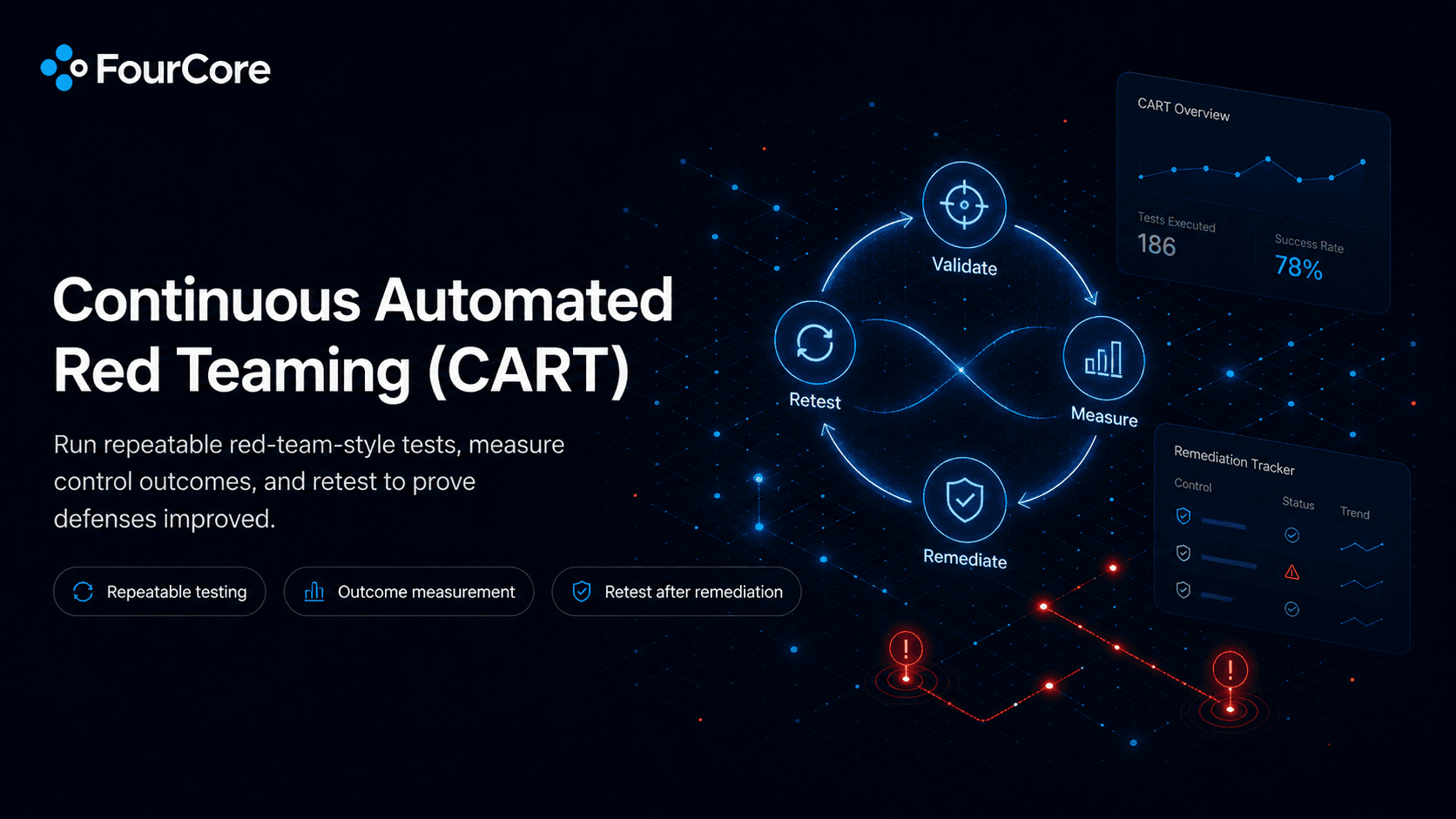
Continuous Automated Red Teaming (CART) automates repeatable, authorized red-team-style tests to measure security control effectiveness frequently. In practice, CART is useful when teams want to retest the same security controls, techniques, and response paths on a regular cadence rather than waiting for an annual assessment.
How FourCore ATTACK Supports CART
FourCore ATTACK helps teams run safe, repeatable adversary simulations and turn the results into actionable evidence. A practical CART workflow in FourCore ATTACK usually follows this pattern:
- Select the scenario: choose the technique or threat behavior that matters most to the business.
- Run a controlled simulation: execute the approved test safely against the in-scope environment.
- Measure the control outcome: see whether the control blocked, detected, or missed the activity.
- Review evidence with the SOC and engineering teams: use logs, command lines, processes, and MITRE ATT&CK context to investigate the result.
- Assign remediation work: route the gap to the right owner, whether it touches endpoint policy, detection logic, hardening, email controls, WAF, DLP, or response playbooks.
- Retest after the change: rerun the same scenario to prove that the fix actually improved the outcome.
That is the loop that makes CART useful. The value is not only that the test ran, but that the team can prove the outcome improved after the change.
What Security Teams Can Validate with CART
In FourCore ATTACK, continuous automated red teaming is most practical when it helps teams answer specific validation questions:
| Control area | What teams can validate |
|---|---|
| Endpoint security | Whether endpoint controls detect or block execution, persistence, credential access, lateral movement, and other MITRE ATT&CK-mapped behaviors |
| Email security | Whether email controls stop payload delivery, malicious attachments, and phishing-led intrusion paths |
| WAF and web controls | Whether web application and gateway controls see suspicious application-layer or outbound behavior |
| Network and outbound controls | Whether command-and-control-style traffic and suspicious connections create useful SOC signals |
| DLP and data movement controls | Whether attempted data movement is detected and blocked before it becomes an incident |
| SOC triage and investigation | Whether telemetry is ingested, enriched, correlated, and usable for fast triage |
| Remediation and retesting | Whether a tuned control, policy, or detection rule produces a better outcome on the next run |
CART vs Red Teaming vs BAS
CART, red teaming, and BAS are related, but they are not identical.
| Approach | Primary purpose | Best suited to |
|---|---|---|
| Human-led red teaming | Broad, objective-driven resilience testing led by operators | Testing people, process, and technology against defined objectives |
| Continuous automated red teaming | Repeat selected techniques with consistent measurement | Rechecking high-priority controls, detections, and response workflows |
| Breach and Attack Simulation (BAS) | Continuous or on-demand security control validation | Measuring whether controls detect, block, or miss realistic attacker behavior |
FourCore ATTACK brings these ideas together through continuous security control validation. Teams can use it for repeatable red-team-style testing, BAS-style control coverage, and evidence-based remediation, depending on the scenario they care about.
Why CART Helps Security Teams
A good CART programme does not replace penetration testing or human-led red teaming. Instead, it gives teams a way to:
- validate the same techniques after every meaningful control change
- show whether a new detection rule actually works
- give SOC teams realistic telemetry to practice against
- shorten the time between a missed control and a proven fix
- produce evidence for leadership, audit, or compliance reporting
That makes CART especially valuable for organisations that need measurable security improvement, not just an annual statement that controls exist.
How FourCore ATTACK Fits into a CART Programme
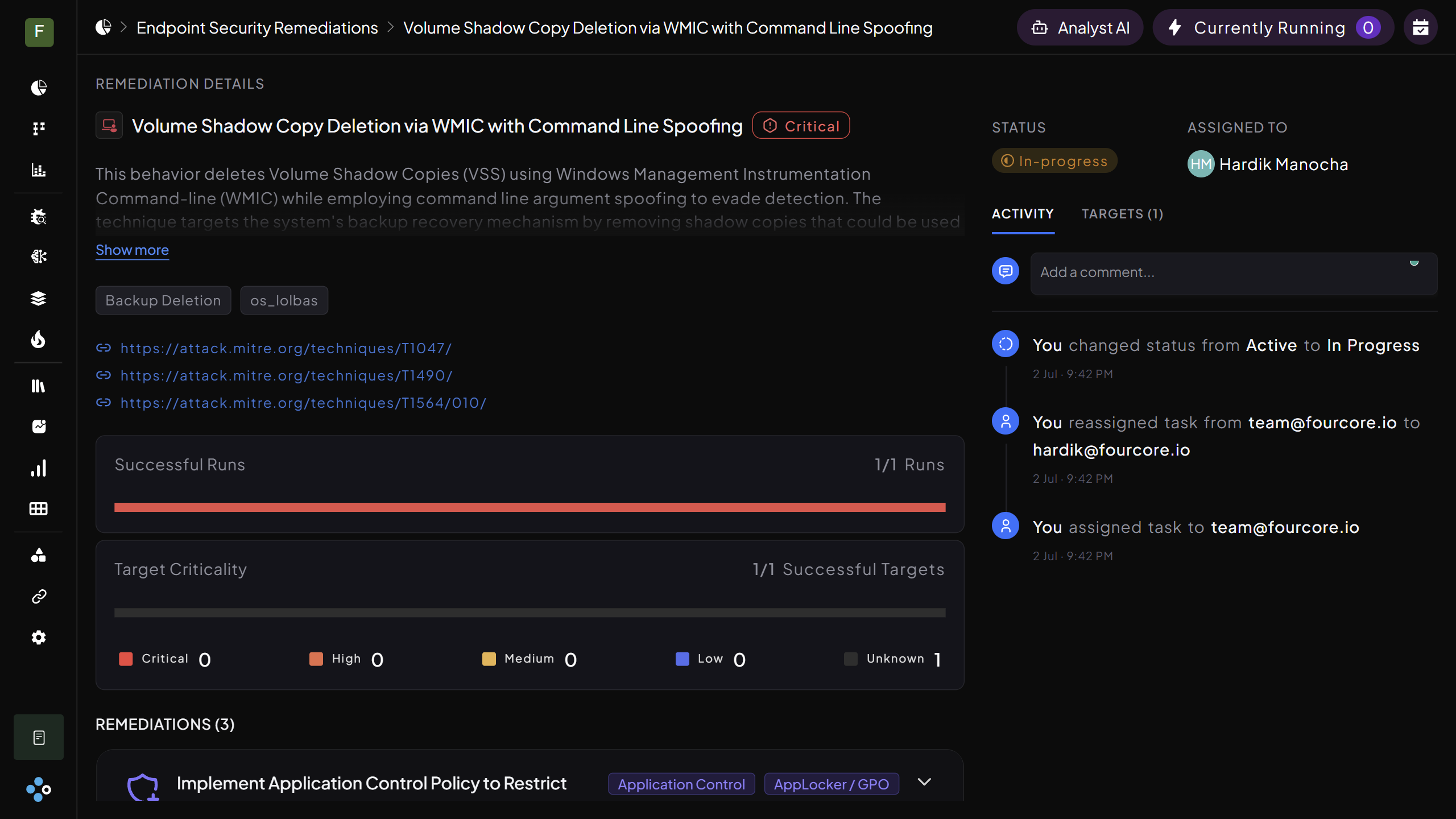
FourCore ATTACK is built around adversarial exposure validation. The platform maps simulations to MITRE ATT&CK, records whether each control blocked or detected the activity, and helps teams route remediation work to the right owners. Teams can then retest the same scenario to confirm the defense improved.
That makes FourCore ATTACK a practical operating platform for CART, because the goal is not only to run a test, but to move from assumption to evidence, and from evidence to a proven fix.
If you want to see how CART works inside your own environment, book a demo. FourCore ATTACK can show how teams select the right scenario, validate the control outcome, and retest after a fix.